
October 1, 2026
EUL at the DTU Offshore Summer School 2026
The international summer school brought together researchers, students, industry professionals, operators and policymakers working on subsurface engineering and the energy transition. The programme covered a broad range of underground storage applications, including CO₂ storage, hydrogen and natural gas storage, thermal energy storage, monitoring, integrity assessment and other emerging uses of the subsurface.
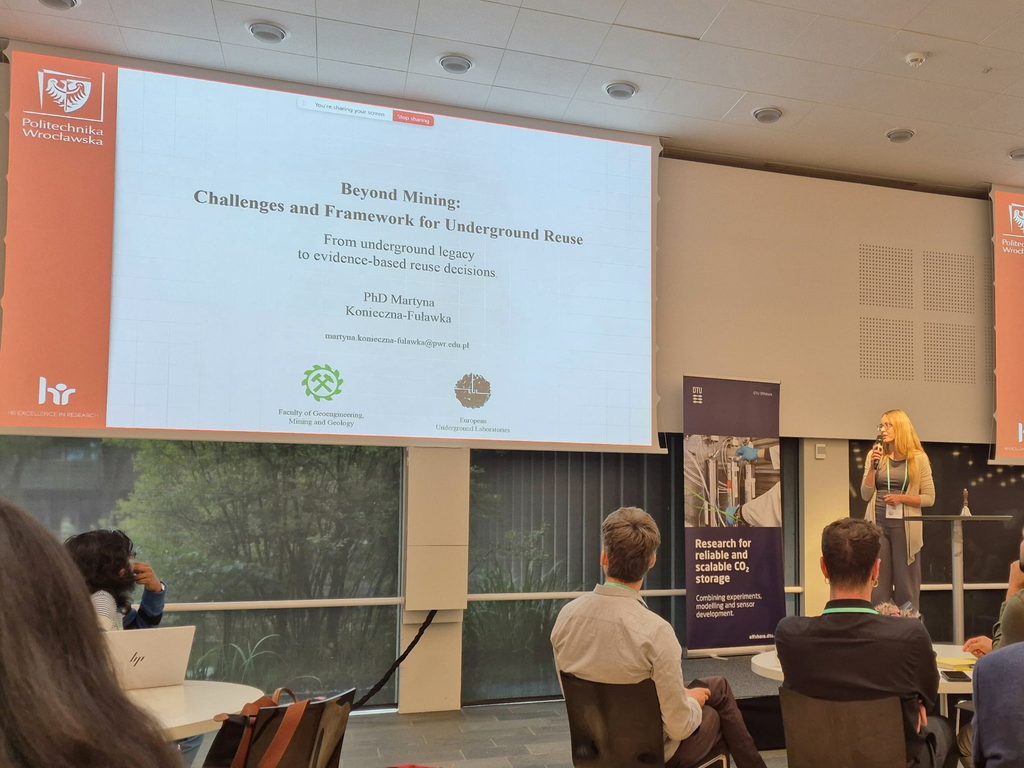
EUL was represented by Dr Martyna Konieczna-Fuławka from Wrocław University of Science and Technology, a member of the Association. Her contribution focused on the challenges and opportunities associated with using underground spaces as research and laboratory infrastructure.
The presentation addressed the potential of existing mines and other underground facilities to support scientific experiments, technology development, monitoring, education and industrial-scale validation. At the same time, it highlighted that the transformation of an underground excavation into a research facility requires much more than physical access to the site.
“Europe already has a large number of underground spaces that could support research and technology development, but their reuse requires much more than simply having access to an excavation. Safety, monitoring, infrastructure, accessibility and long-term suitability all have to be considered if these sites are to become reliable research environments.” said Martyna Konieczna-Fuławka.
This issue is central to the mission of EUL. Underground facilities can offer realistic conditions for testing technologies that are difficult to validate at surface or laboratory scale, including autonomous systems, geotechnical monitoring, sensing technologies, energy-storage solutions and underground robotics. For European industry, such facilities can shorten the path from laboratory research to real-world demonstration. Instead of creating entirely new test environments, existing underground infrastructure can be adapted to support innovation, provided that its technical condition and long-term safety are properly assessed.
Participation in the DTU Summer School therefore provided an important opportunity to connect the EUL network with the wider European community working on subsurface technologies, energy transition and the sustainable reuse of underground infrastructure.